
Rights and Obligations of a Private Detective in Spain: What the Law Says
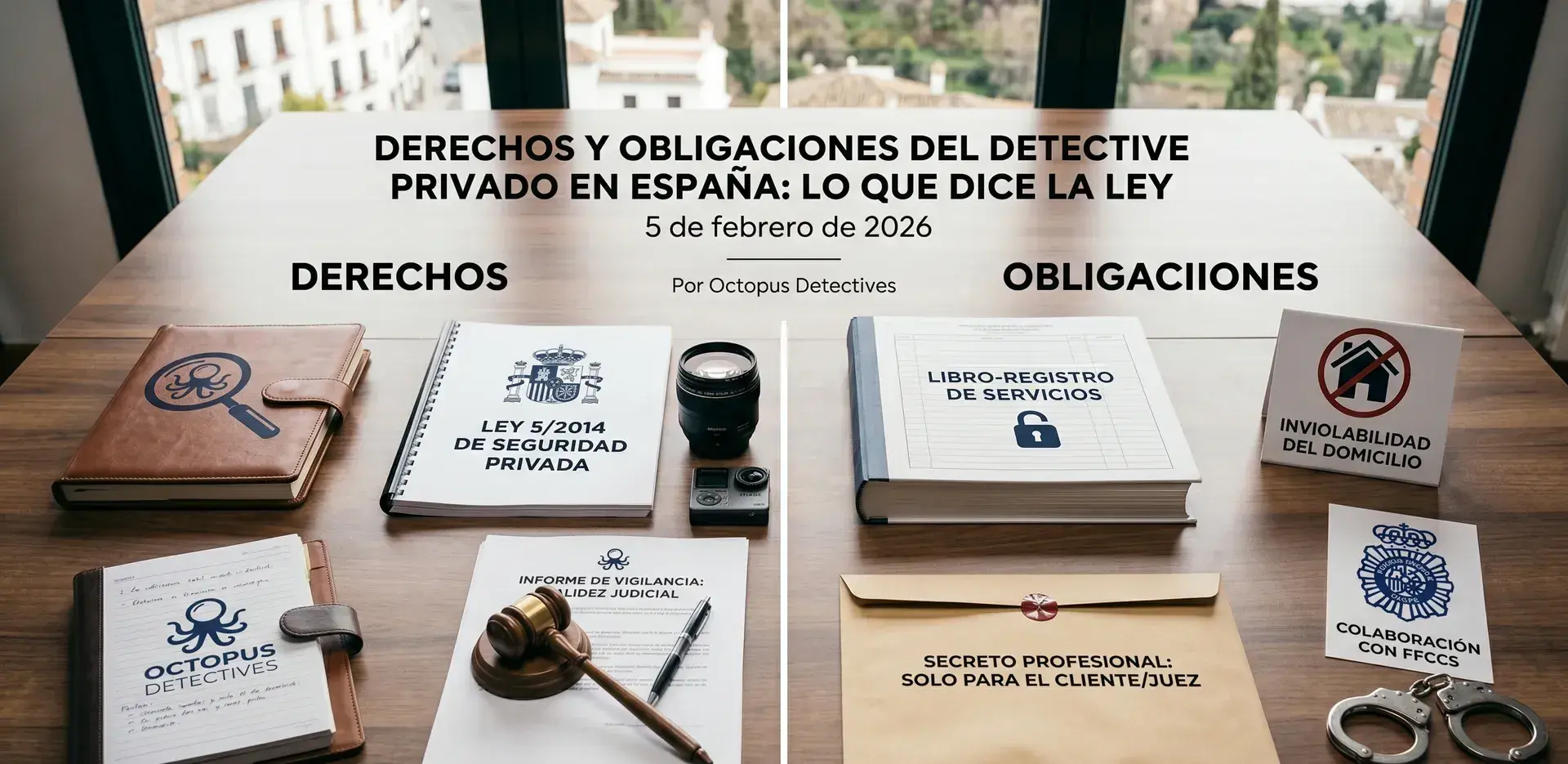
Hiring a private detective in Spain without understanding the legal framework is a risk. If the detective acts outside the law, the evidence obtained may be inadmissible in court — or worse, you could face legal consequences yourself. This article explains what the law says, what a licensed detective can do, and what they are prohibited from doing.
The governing law: Private Security Act 5/2014
Private detective activity in Spain is regulated by Law 5/2014 on Private Security and its implementing regulations. The key points for the client:
- Only detectives with a TIP (Professional Identification Card) issued by the Ministry of the Interior may carry out paid private investigation activities.
- Detectives must be registered in the National Security Registry (RNSP).
- The activity is subject to professional secrecy: the detective cannot disclose the client's identity or the content of the investigation without the client's authorisation, except by judicial order.
- Investigations may only be carried out in the interests of natural or legal persons for legitimate purposes.
What a detective CAN legally do
- Surveillance and tracking in public spaces: streets, car parks, restaurants, beaches, parks — anywhere the public has free access.
- Photography and video recording in public spaces or of visible elements from public spaces.
- Open source intelligence (OSINT): searching publicly accessible sources (social networks, public registries, news archives).
- Interviews with third parties who agree to speak voluntarily.
- Producing an expert report with forensic value, admissible in civil, family and labour proceedings.
- Court ratification: the detective can appear in court and ratify their report under oath, submitting to cross-examination by all parties.
What a detective CANNOT legally do
- Access private spaces without the occupant's consent (private homes, private offices).
- Intercept communications (telephone calls, messages, emails): this is only possible with a judicial warrant, which can only be obtained by the State's security forces.
- Access restricted police or State databases (criminal records, DGT data, tax records).
- Install tracking devices on a vehicle or person without the owner's consent.
- Impersonate authority or a public official.
- Act for an employer against a worker in collective bargaining or union activity (prohibited by the Workers' Statute).
When is the detective's evidence admissible in court?
Evidence gathered by a licensed detective — with a TIP, acting within the law and in public spaces — is fully admissible in civil, family, labour and commercial proceedings as expert evidence. The detective signs the report with their professional credentials and can be cross-examined in court.
Evidence is inadmissible if it was obtained by violating fundamental rights (e.g., intercepting communications without a judicial warrant, entering a private home without consent), or if the person acting as "detective" did not have a TIP licence.
How to verify that the detective you hire is licensed
- Ask for their TIP number and verify it with the Ministry of the Interior.
- Check their registration in the RNSP (National Security Personnel Registry).
- They should issue a written contract with their TIP and identification data.
- Any agency refusing to provide their TIP number is operating outside the law.
Octopus Detectives: TIP 6206 · RNSP 11655. You can verify these data with the Spanish Ministry of the Interior.
Questions about what a detective can do in your case?
Free first consultation. We explain honestly what is and is not legally possible for your specific situation.
☎ 608 855 099 · Contact us →