
Asset Investigation in Divorces with Coastal Property: Villas, Holiday Rentals and Commercial Units
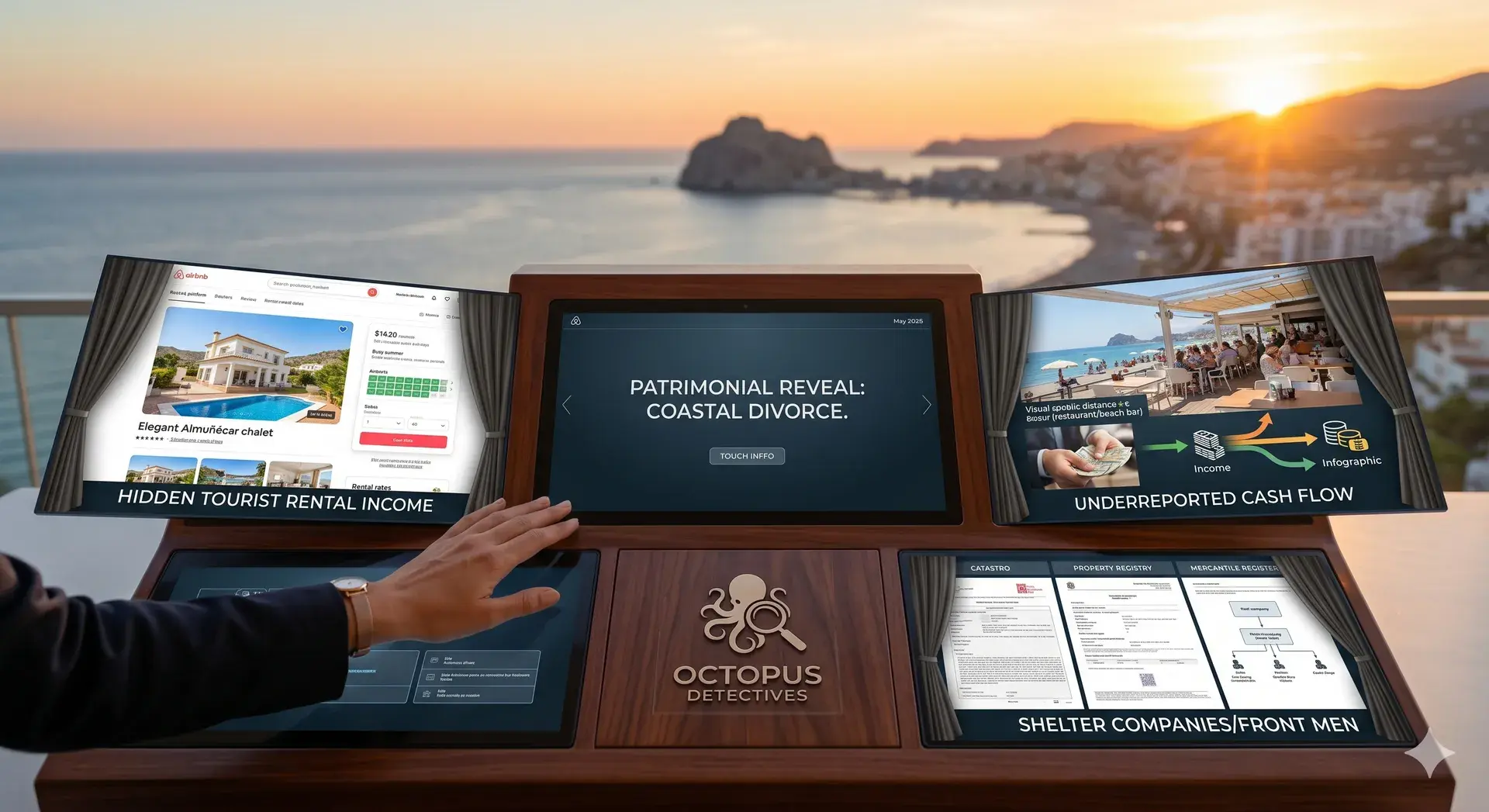
In a contested divorce involving property on the Costa Tropical or any other coastal area, a pattern recurs: one party presents an asset declaration that does not match the visible lifestyle, the real rental yield of the properties declared, or publicly verifiable financial movements. The suspicion of hidden assets is reasonable, but it needs to be converted into evidence for the court to consider it.
In this article we explain what can be legally investigated, the methods used, the validity of the detective's report before a family court, and the typical cases we see along the Granada coastline: villas, holiday-let apartments, commercial units and asset-holding companies.
What can a detective legally investigate in a coastal divorce?
A private detective operates in the public domain and uses open-source intelligence (OSINT). Specifically, they can document:
- Physical use of the property: is the declared holiday home actually rented out on Airbnb or Booking.com? Is it inhabited all year round by an undeclared partner? Is it undergoing renovation inconsistent with a declared financial situation?
- Apparent lifestyle: vehicle used, restaurants frequented, trips taken, social activities — all in public spaces or publicly accessible social media.
- Business activity: who enters and leaves a commercial unit, operating hours, volume of visible activity.
- Cohabitation: whether the other party lives alone or with a partner, and whether an undeclared rental property generates income.
Most common coastal-divorce cases we handle
1. Undeclared holiday rental
The most frequent coastal case. The property is declared as a family holiday home of "low value", but in practice it is listed on rental platforms and generating substantial income. We document the active listing, verify occupation through on-site observation, and photograph the property's external condition compared to the declared investment level.
2. Villa or apartment held in a third party's name
A parent, sibling or company appears as the titleholder of a coastal property that the other spouse effectively uses and enjoys. The detective documents who actually uses the property, who maintains it, who pays for improvements — information that the family court's asset expert uses to pierce the corporate veil.
3. Undeclared commercial income
A restaurant, beach bar or local business that the other party claims to earn "very little" from shows a level of activity — staff, continuous occupation, number of covers, delivery vehicles — inconsistent with the income declared in the proceedings.
4. Lifestyle incompatible with declared income
The subject claims to have low income but travels, dines out regularly, maintains luxury vehicles and renovates properties. Documenting this publicly visible lifestyle does not prove exactly what income they have, but it raises a presumption that the court can ask the forensic accountant to investigate further.
What the detective's report contributes in court
The detective's expert report is a document that a TIP-licensed detective submits in family court proceedings, either at the client's request or via their solicitor. Its evidentiary value lies in: (1) it was obtained by a licensed professional under the Private Security Act 5/2014, (2) it documents verifiable facts — not opinions — with photographs, video and date/time stamps, and (3) the detective is available to ratify and be cross-examined in court.
The report does not replace the forensic accountant or the registry expert — it complements them. The detective provides the "visible reality" that official registries often do not reflect.
Do you suspect hidden assets in a coastal divorce?
Free first consultation to assess your case. We work alongside your solicitor and provide reports valid before the family courts of Granada and Málaga.
☎ 608 855 099 · Request a free consultation →